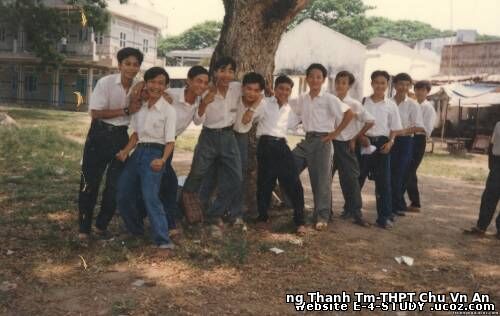
Studying at High School and University  I am a first-year student of An Giang University. I am very happy that I can continue my studies so that I will become a teacher as I have wished for years. Some years ago, I used to think that everything at high school and at university was similar, so I was surprised when I first came to An Giang University because it was very different; however, there were also some similarities. Now I would like to tell you about the similarities and the differences between life as a high school student and life as a university student. I was proud that I was a student of Thoai Ngoc Hau High School. It was the most famous school of An Giang Province, so it was rather large. There were thirty six classes with over four hundred students and about sixty teachers. It had two computer labs but they were single-user computers, so we used them only to study informatics. There was also a library, it was rather small compared with a well-equipped public library. When we studied gymnastics or organized sport matches, we entered the gymnasium; however, it didn’t have enough apparatuses. The school-yard was wide enough for us to play sports after 5 p.m everyday. When we felt sick or had a pain in our body, we could have come to the school clinic. Every month, we had some activities for each subject such as presenting small plays, participating in drawing contests and telling  stories. Those helped us review our lessons and cultivate our minds. Nevertheless, we were often very stressful because we had to study fifteen subjects each year, so we had to take so many tests that we didn’t have much time to play sports with our friends and to do anything we liked. It was so boring that we sometimes fell asleep in our class, our teachers explained all the lessons for us and we had to write very fast and learned by heart all them. Although there were many things we weren’t clear on, we asked our teachers only after our class finished because each period had forty five minutes, it wasn’t enough stories. Those helped us review our lessons and cultivate our minds. Nevertheless, we were often very stressful because we had to study fifteen subjects each year, so we had to take so many tests that we didn’t have much time to play sports with our friends and to do anything we liked. It was so boring that we sometimes fell asleep in our class, our teachers explained all the lessons for us and we had to write very fast and learned by heart all them. Although there were many things we weren’t clear on, we asked our teachers only after our class finished because each period had forty five minutes, it wasn’t enough
for us to discuss while studying. Our teachers were nice, but most of our friends were unfriendly and they were often dishonest while doing tests because they weren’t well-prepared before.Now I am studying at An Giang University. It is rather well-equipped. Its campus is very wide. There are over ninety classes with many students and instructors. The library is large and it has many kinds of books, cassettes and networked computers, so we can get information for our studies easily because we usually study by ourselves. We usually have presentations. It is useful that we can remember all the lessons clearly because we have to read a lot of books and prepare carefully in order that our presentations will be good enough and attract our classmates. Besides, we will feel more and more self-confident whenever we appear in front of many people, we also have a unified spirit when we study in group. Most of the members in my class are very nice, friendly and active. We always help our classmates when they have problems or give them advice when they make mistakes so that we will become better and better. There is an English Speaking Club which was organized twice a month so as to improve our speaking skill and communication skill, we have many friends when taking part in this club, they are friendly and sociable. In addition, there are some foreigner teachers at my university, we can ask them about many things which we aren’t clear, they are willing to help us, it is also a good condition for us to practice speaking English and to improve our knowledge.When being at high school, we had a flag greeting-ceremony every Monday. School managing board summed up all the activities of the previous week, gave their ideas and promoted new plans for that week. It was very good, but now we don’t have that period. Besides, we study less subjects than we did at high school, so we can relax by playing sports and participating in many activities after hard-studying days. There are much more students and teachers than my high school, the library is larger and the campus is wider. In addition, I didn’t have good conditions to practice speaking English at high school because many students disliked it and felt shy when speaking, there were no also foreigner teachers and English Speaking Club. Seldom did we study in group because we didn’t have presentations at high school. Now studying in group is very necessary because if we don’t, we can’t have a good group presentation. The biggest difference between university and high school is the method of teaching and studying, so we felt strange at the beginning of this school-year. However, we have got acquainted with all the differences up until now.In my opinion, studying at university is more interesting than studying at high school. It has a lot of good conditions for us to study, to relax and to develop our skills. It is very bad for our health if we only study without relaxing and we will feel very sad if we have just a few friends. There are a lot of good chances, so we should make use of them to study better and better in order that our country will become an industrialized nation.Phan Duc Duy - 9D2
|
 International Cooperation has been being considered one of the tasks of priority in the development strategy of the University of Social Sciences and Humanities (USSH). At present, the USSH has signed cooperative agreements with more than 100 international partners including universities, institutions, foundations, agencies, organizations from many countries: - Argentine: National University of La Plata (Institute of International Relations), National University of Rio Cuarto.
- Australia:
University of New South Wales (Korea - Australasia Research Centre ), Australia National University (Research School of Pacific and Asian
Studies), Willcox English College, - Belgium: Vrije Universiteit Brussel
- Brazil: University of Brasilia Foundation
- Canada: University of Quebec in Abitibi-Témiscamingue
- China:
Baise College, Beijing University for Finance and Economics, Guangdong University for Foreign Studies, Guangxi Economic Management Cadre College, Guangxi Normal University, Guangxi Education College, Guangxi College of Finance and Economics, Guangxi University for Nationalities, Guangxi Dongfang Foreign Language College, Guangxi University, Peiking University, Qinzhou College, Yunnan Nationalities University, Zhongsan University. - Czech Republic: Tomas Bata University in Zlin, University of Defence, University of Ostrava.
- France:
AUF, Center for Culture and Cooperation of the Embassy of France in Hanoi, Nîmes University, Centre for Study and Research, University of Toulouse - Le Mirail, Montesquieu University - Bordeaux IV, PUF, University Pierre Mendès France (Grenobles II), University of Paul Valéry Montpellier III, University of Paris 7 - Denis Diderot. - Germany:
Commission for General and Comparative Archaeology (KAVA) of the German Institute of Archaeology, Institute of Missiology Missio e.V, Johannes
Gutenberg University, Mainz (Institute of Indology), Konrad-Adenauer Foundation, Marburg Archive School, Munich University of Applied
Sciences, Rosa Luxemburg Foundation, University of Passau, University of Applied Sciences, Potsdam, University of Greifwald. - Italy: Carlo M. Lerici Foundation
- Ireland: Waterford Institute of Technology
- Japan:
Daito Bunka University, Evidence Japan Limited Corporation, Fukushima University, Hagoromo International University, Ibaraki University, Japan Foundation, JICA, Kanda University of International Studies, Kyorin University, Osaka University of Economics and Law, Rikkyo University, Senshu University, Showa Women’s University, Toyota Foundation, Toshiba Foundation, University of Tokyo (College of Arts and Sciences). - Korea: Academy of Korean
Studies, Academy of East Asian Studies, Ajou University, Baeron, Inc., Chung-soo Scholarship Foundation, Chungwoon University, Hannam University, Hankuk University of Foreign Studies, HanViet Foundation, Inha University, KOICA, Konkuk University, Korea Foundation, Kwandong University, Sangmyung University, Seoul National University, Seoul Women’s University, SungKyungKwan University, Yonsei University, Youngdong University. - New Zealand: Victoria University of Wellington
- Russia:
Lomonosov Moscow State University (Faculty of Psychology), Moscow State Institute of International Relations (University), Moscow State University (Institute of Asian and African Studies), Tambov State Technical University. - Singapore: National University of Singapore (Faculty of Arts and Social Sciences)
- Sweden: Save the Children
- Taiwan:
Chaoyang University of Technology, Chihlee Institute of Technology, Fujen Catholic University, Kainan University, Kun Shan University, Ling Tung University, Meiho Institute of Technology, Na Jeon Institute of Technology, National Taiwan University of Science and Technology, National Yunlin University of Science and Technology, Shu-te University, Vanung University, Yuanpei University, Yuda College of Business, Wenzao Ursuline College of Languages. - Thailand:
Bansomdejchaopraya Rajabhat University, Chiangmai University, Mahasarakham University, Nakhon Pathom Rajabhat University, Naresuan University, Payap University, Phranakhon Rajabhat University, Sakon Nakhon Rajabhat University, Silpakorn University, Suan Sunandha Rajabhat University. - USA: Asia Foundation, Center for Intercultural Education and Development - Georgetown University, Council on International Educational Exchange, Ford Foundation, George Washington University (Program for International Studies in Asia), Princeton University, Texax Tech University, University of California, Riverside (International Education Programs).
- Uzbekistan: Tashkent State University of Oriental Studies.
Various
forms of international cooperation, such as scholar and student
exchanges, delivery of short-term courses, organizing international
conferences, and collaborating in joint-research programs, have been
expanding. Most of these cooperative activities are bilateral and
multilateral. In the future, there will be a further expansion of
multilateral cooperation with more partners. International Cooperation in TrainingThe University of Social Sciences and Humanities has been carrying out several programs in cooperation with foreign partners: - Short-term
Programs with Council on International Education Exchange, University
of California, California State University, Long Beach, Princeton
University, University of Puget Sound (USA), Beijing University,
Beijing University for Finance and Economics, Guangdong University for
Foreign Studies, Guangxi University for Finance and Economics (China),
Victoria University (Australia), Thammasat University,
Bansomdejchaopraya Rajabhat University (Thailand). - 3+1, 2+2
Joint Training Programs on Vietnamese Studies with many universities in
China such as: Guangxi University for Nationalities, Yunnan University
for Nationalities, Guangxi Dongfang Foreign Language College, Guangxi
Education College (China). - Joint Training Program with Toulouse
II in Management of Organizations and Psychology for Development of
Infants and Adolescents, Hospitality Management at graduate level.
International Cooperation in ResearchThe
University of Social Sciences and Humanities has been implementing a
number of important research projects and collaborating with different
agencies inside and outside the country in national, regional and
international research programs with funds from foreign foundations
such as: Development of Sociology, Project on Film Studies, Training
Thai Language, Anthropology (Ford Foundation), The Social Market
Economy (Konrad Adenauer Foundation), Development of American Studies,
Development of International Studies (Asia Foundation), Making Policies
on Scientific, Technological and Educational Development (Rosa
Luxemburg Foundation). Besides projects, the University of
Social Sciences and Humanities have been hosted a number of famous
international conferences such as: Dien Bien Phu - 50 Years of
Retrospection, Vietnam in the Process of Unification, Renovation and
Integration, The Sixth Pan-Asiatic International Symposium on Languages
and Linguistics, Vietnam and Its Accession to the WTO, Countryside in
Transition, Culture in Globalization, Korea and Korean Studies from
Asian Vision... These activities have practically and effectively
contributed to the socio-economic, cultural and political development
of the country. The USSH has been collaborating with international
partners to organize symposia and conferences. International Cooperation PrioritiesIn the future, the University of Social Sciences and Humanities gives priority to advancing the following plans and programs: - Developing joint training programs on Vietnamese Studies with international partners under the model: 3+1, 2+2.
- Exploring and implementing projects to conduct joint researches, to organize symposia and to improve faculty capacities.
- Internationalizing curricula on Psychology, Sociology, Tourism, Intellectual Property and Management Science.
- Promoting Study Program at Hanoi branch of a foreign university.
|
The International Federation of Red Cross and Red Crescent Societies is launching a global information campaign to help communities deal with the Swine Flu virus. The Red Cross says its main focus will be on the developing countries, which do not have the same level of medical and monitoring facilities as the developed countries. The Red Cross says people in developing countries are most vulnerable to the H1N1 Swine Flu virus. But, they also are most likely not to have the information they need that could save their lives. So, while the campaign is global, the Red Cross says a priority is to reach people in the most remote corners of the world within the next few weeks with its life-saving messages. Tamman Aloudat, IFRC Sr. Officer, Health in Emergencies, at a press briefing about the H1N1 campaign in Geneva, Switzerland, 04 Sep 2009
Tamman Aloudat, IFRC Sr. Officer, Health in Emergencies, at a press briefing about the H1N1 campaign in Geneva, Switzerland, 04 Sep 2009
Senior Red Cross Officer for Health in Emergencies, Tammam Aloudat, says countries in the Northern hemisphere have gone through the first wave of the Swine flu pandemic and now have to prepare for a second wave of the virus. He  says no one knows whether the second wave will be more severe than the first or will remain moderate. says no one knows whether the second wave will be more severe than the first or will remain moderate. "It does not really matter because in the best case scenario we have today, we will still have a moderate virus that … is projected to cause several million deaths extra deaths than the usual influenza annual mortality, which means that even in the best-case scenario, we do have an emergency on our hand," said Aloudat. "An emergency of a scale different to what we have seen before in the modern era." Pandemic experts explain a second wave does not necessarily entail any change in the composition of the virus. They say the virus can stay exactly the same. But, it usually finds more susceptible populations to infect among the people who did not get the disease in the first wave. So, they lack the immunity to fight off the disease. Robert Kaufman, Head of IFRC human pandemic preparedness unit, at a Geneva press briefing about the H1N1 campaign, Switzerland, 04 Sep 2009
Robert Kaufman, Head of IFRC human pandemic preparedness unit, at a Geneva press briefing about the H1N1 campaign, Switzerland, 04 Sep 2009
Head of the International Red Cross Federation's Influenza team, Robert Kaufman, says the impact of a novel virus on a community without immunity is not just about the number of illnesses and deaths. It is also about its ability to disrupt services. "For example, we saw in the southern Hemisphere-in Chile, Argentina, certain parts of Bolivia where health facilities were overwhelmed. Operations for people were postponed because facilities and medical practitioners were preoccupied and needed to serve influenza like diseases or flu in particular," he said. Pharmaceutical companies are developing vaccines against H1N1. They are expected to be available in the coming weeks. But, there will not be enough vaccine for everyone and there are fears that the developing countries will be short-changed. While vaccines are important, Red Cross officials say they are not the only way for people to stay safe. They say those who follow five practices will greatly reduce the risk of becoming infected. The message the Red Cross campaign is trying to get out is simple - wash your hands, cover your mouth, keep your distance, separate your sick and dispose of your waste properly.
| |















 with at least a 1024 x 768 screen resolution.